请双击输入内容...


Tel: +86-20-86181657

Email: sales@sunrans.com
Share to:












- Media News -
Dual-Zone Swim Spa Guide: Benefits, Layouts and Best Applications
Time: 2026-09-09 17:09:42
Author: SUNRANS
Click:
Learn how dual-zone swim spas work, when independent temperatures add value, and what buyers should compare in layout, systems, installation and cost.
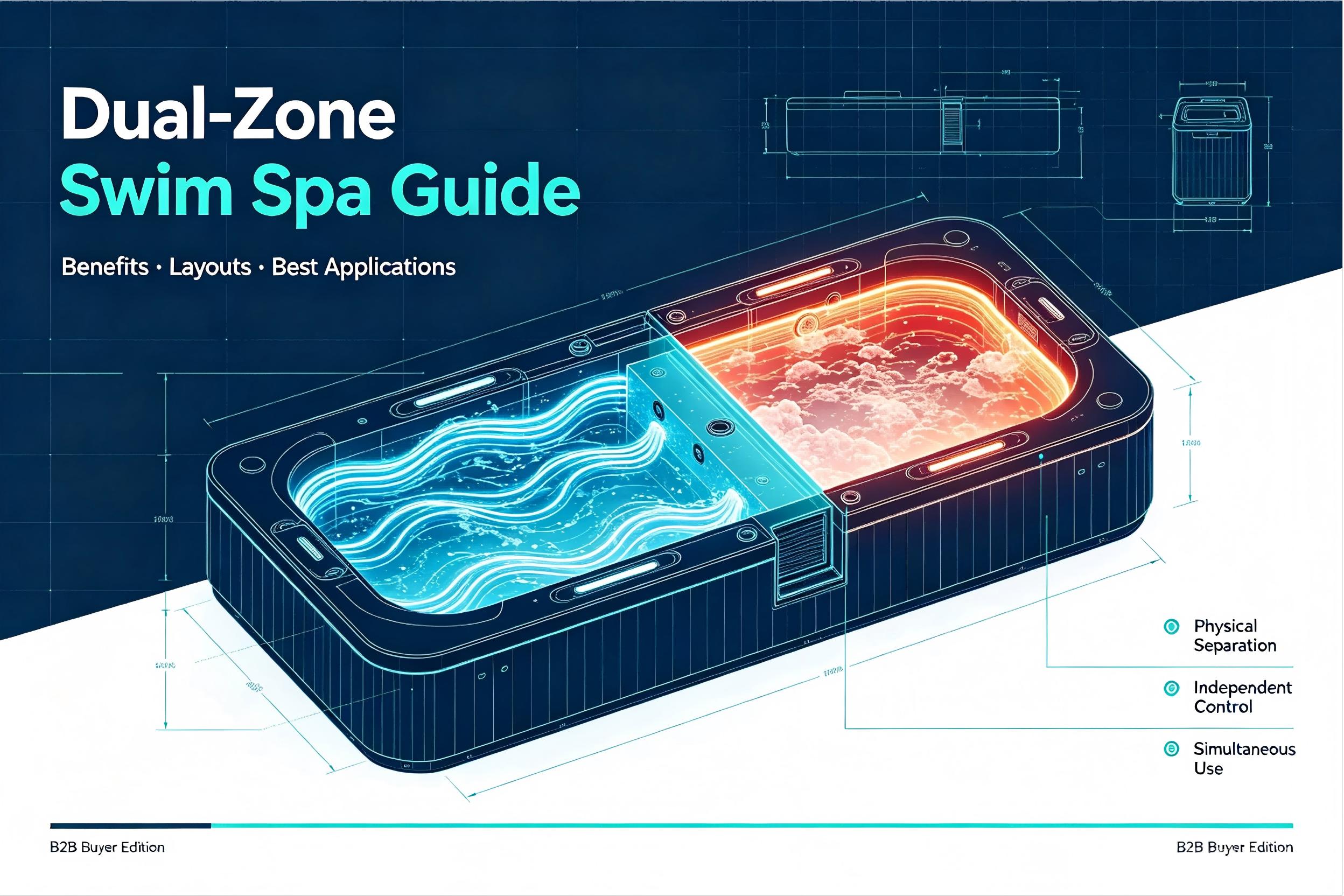
Dual-Zone Swim Spa Guide: Benefits, Layouts and Best Applications
Buyer Context and Decision Scope
A swim spa with therapy seats is not automatically dual zone. A true dual-zone layout uses a physical separation between the swim and hot-tub water so each area can be controlled for a different activity and, where the exact model supports it, a different temperature. That separation creates value only when the household or project will use it.
For B2B buyers, the decision should start with temperature conflict and simultaneous use. If one user wants exercise-friendly water while another wants a warmer seated experience, dual zone can solve a real problem. If activities occur at different times and one temperature is acceptable, a single zone may provide more continuous space with fewer systems.
What Is a Dual-Zone Swim Spa?
A dual-zone unit contains a swim area and a physically separated hot-tub or therapy area within one integrated product. Each zone has its own water volume; pumps, controls, heating, filtration and sanitation may be independent or arranged in a model-specific architecture. For distributors and project buyers, the phrase must be verified against the actual hydraulic and control design rather than inferred from the presence of seats. Record the answer against the exact model, destination market and document revision because a family-level statement may not apply to every configuration.
Ask whether temperatures are independently controlled, which equipment is shared, how zones are isolated and how each is drained, filled, filtered and serviced. Distinguish it from a single zone with massage seats. Ask the supplier to provide labeled plan, zone-by-zone schematic, equipment list, control manual and wet demonstration. Use dual zone in marketing only when the approved model documentation confirms two separated water systems and functions. Where suppliers use different terms, translate each response into the same scorecard field and keep assumptions visible for the technical reviewer.
The Main Benefits
Independent zones allow exercise and warmer relaxation without repeatedly changing one body of water. Different users can use the product at the same time, and the combination can support daily fitness, family routines and premium wellness positioning. For distributors and project buyers, value comes from frequency and conflict resolution, not simply from a larger or more luxurious appearance. Record the answer against the exact model, destination market and document revision because a family-level statement may not apply to every configuration.
Estimate how often both zones will be occupied, who uses each, preferred temperatures and whether the household or facility can supervise and maintain them. Consider how separate covers and controls affect routine use. Ask the supplier to provide a user schedule, temperature/use-case map and demonstration of simultaneous operation. Dual zone is justified when independent temperatures or simultaneous activities create recurring value. Where suppliers use different terms, translate each response into the same scorecard field and keep assumptions visible for the technical reviewer.
Common Layouts and Configuration Choices
Manufacturers can allocate more length to the swim zone or more area to the hot-tub zone. The swim side may use jet or propeller current, while the hot-tub side can use upright seats, loungers and varied therapy zones. For distributors and project buyers, zone proportion should reflect the primary swimmer and the number of seated users rather than a standard visual formula. Record the answer against the exact model, destination market and document revision because a family-level statement may not apply to every configuration.
Review usable swim length, current outlet and body position, divider, entry, hot-tub seating, footwell, jet zones, controls, filters, covers and equipment-bay locations. Confirm which features are standard or optional. Ask the supplier to provide dimensioned plan, jet/seat map, current test data, BOM, cover drawing and configuration matrix. Protect the primary use first; extra seating should not compromise the swimmer or make service access impractical. Where suppliers use different terms, translate each response into the same scorecard field and keep assumptions visible for the technical reviewer.
Best Residential and Commercial Applications
Premium households with mixed temperature preferences, villas and chalets can use both zones as one outdoor-wellness installation. Hotels and resorts may value differentiated guest experiences; fitness or supervised rehabilitation settings may value separate activities without making medical outcome claims. For distributors and project buyers, commercial suitability depends on duty, throughput, supervision, accessibility and water-management rules, not residential marketing. Record the answer against the exact model, destination market and document revision because a family-level statement may not apply to every configuration.
For homes, evaluate routine, privacy, noise and maintenance ownership. For projects, add staff training, cleaning, guest flow, accessibility, emergency procedure, downtime and local operating requirements. Ask the supplier to provide use-case brief, duty and compliance review, accessibility plan, maintenance schedule and references from comparable settings. Do not present a residential dual-zone unit as commercially suitable until the complete project has been reviewed. Where suppliers use different terms, translate each response into the same scorecard field and keep assumptions visible for the technical reviewer.
Installation and Site Planning
Dual-zone products are typically longer and contain more water and equipment than comparable single-zone units. The project must verify external dimensions, dry and filled load, support, delivery/lifting, final orientation, electrical supply, drainage, cover movement and service access. For distributors and project buyers, a larger footprint can fit on paper while failing at the gate, crane radius, base or equipment-bay interface. Record the answer against the exact model, destination market and document revision because a family-level statement may not apply to every configuration.
Overlay the approved drawing on the site and mark each access panel, connection and cover segment. Coordinate any verified heat-pump option with plumbing, power, airflow and service space. Ask the supplier to provide current plan/elevation, packed data, lifting plan, structural review, electrical design and site sign-off. Place a hold on delivery until all site, utility and service interfaces are resolved. Where suppliers use different terms, translate each response into the same scorecard field and keep assumptions visible for the technical reviewer.
Energy and Ownership Considerations
Two zones introduce separate water volumes, set points, covers and operating schedules. Energy depends on climate, insulation, cover use, temperature difference, standby settings, filtration and frequency; a universal running-cost or payback claim is not reliable. For distributors and project buyers, the flexibility benefit should be evaluated against actual household or project use and the ability to maintain two systems. Record the answer against the exact model, destination market and document revision because a family-level statement may not apply to every configuration.
Build base, expected and high-use scenarios. Keep power ratings, ambient temperature, set points, hours, tariff, water care, filters, service and downtime visible. Ask the supplier to provide rated equipment data, envelope/cover specification and an editable scenario calculator. Compare total ownership under matched assumptions rather than claiming that combined products automatically save energy or cost. Where suppliers use different terms, translate each response into the same scorecard field and keep assumptions visible for the technical reviewer.
Questions to Ask the Manufacturer
The RFQ should identify zone isolation, current system, controls, pumps, heaters, filtration, sanitation, insulation, covers, service access, certificate scope, commissioning, parts and remote diagnosis. Every answer must match the quoted model and destination. For distributors and project buyers, a dual-zone configuration creates more interfaces that need controlled drawings and support. Record the answer against the exact model, destination market and document revision because a family-level statement may not apply to every configuration.
Ask which components are shared, how a zone fault affects the other, how temperatures are managed, what technicians can access, and which customization changes require engineering or certification review. Ask the supplier to provide current BOM, schematics, manuals, certificate/report scope, installation pack, spare-parts list and warranty workflow. Shortlist only configurations whose technical evidence and after-sales plan are complete enough for local service. Where suppliers use different terms, translate each response into the same scorecard field and keep assumptions visible for the technical reviewer.

B2B Comparison Matrix
Use the matrix below to normalize supplier and model responses. Every row should be linked to a current document, test or responsible reviewer rather than accepted as an unsupported catalog claim.
Decision factor | Single-zone swim spa | Dual-zone swim spa | Buyer question |
Water/temperature | One body of water and one operating temperature | Separated swim and hot-tub water with independent capability as specified | Do users need different temperatures at the same time? |
Usable space | More continuous space within a comparable footprint | Space divided between swim and hot-tub zones | Which activity and user count must be protected? |
Systems | Fewer zones, covers and equipment interfaces | More controls, equipment and service decisions | Can the dealer commission and support both zones? |
Site | Generally shorter and simpler, model dependent | Generally larger with greater load/logistics implications | Do access, base, utilities and covers fit the site? |
Value | Good where activities share time and temperature | Strong where temperature conflict or simultaneous use is frequent | Will the second zone be used often enough to justify complexity? |
Dual-Zone Manufacturer Questions
Mark each item as verified, conditional or open. Record the evidence source, revision and person responsible for closure.
1. Confirm physical zone separation and independent temperature/control capability.
2. List swim current, pumps, heaters, filtration, sanitation and controls by zone.
3. Provide zone dimensions, usable swim area, seating/jet map and cover arrangement.
4. Verify dry/filled load, packed data, lifting, connections and service panels.
5. Match destination voltage and certificate scope to the exact configuration.
6. Define commissioning, diagnostics, shared-fault behavior, parts and warranty workflow.
Final Recommendation
A dual-zone swim spa is valuable when two temperatures or simultaneous activities solve a real recurring need. That flexibility comes with a larger project envelope and more systems to install and support. Qualify the users first, then validate zone architecture, site fit, operating assumptions and after-sales evidence at model level.
Frequently Asked Questions
What is a dual-zone swim spa?
It is an integrated product with two physically separated bodies of water, normally a swim area and a hot-tub area. The exact controls, heating, filtration and shared components vary, so verify independent functions for the quoted model.
Can both zones have different temperatures?
That is a central purpose of many dual-zone designs, but the exact range and independence must be confirmed in the current model manual and control specification. Do not publish temperatures from memory.
Is a dual-zone swim spa more expensive to run?
It has two water zones and more operating variables, but actual cost depends on climate, insulation, covers, set points, schedules, power ratings and tariffs. Use a scenario calculator rather than a universal conclusion.
How much space does a dual-zone swim spa need?
Use the exact external and packed dimensions plus delivery, lifting, cover, steps, utilities and service clearance. Dual-zone models are commonly longer than single-zone products, but there is no universal size.
Is a dual-zone swim spa suitable for hotels?
It can support premium hospitality concepts, subject to commercial duty, local rules, accessibility, supervision, water treatment, maintenance, staff training and service response. Residential suitability alone is not enough.
What should distributors compare between dual-zone models?
Compare zone proportions, current, seating, independent controls and temperatures, pumps, heating, filtration, sanitation, insulation, covers, site/load, compliance, commissioning, service access, parts and warranty workflow.

点击右上角
分享给朋友吧







 Long by picture save/share
0

English
- 中文
- English
Share to:  |
|
Copyright© GUANGZHOU SUNRANS SANITARY WARE CO.,LTD
粤ICP备17099389号-2
Contact us
Tel: +86-20-86181657 Email: sales@sunrans.com
Share to
Contact us Tel: +86-020-26231998 Email: sales@sunrans.com Post code: 511300
Copyright © GUANGZHOU SUNRANS SANITARY WARE CO.,LTD 粤ICP备17099389号
