请双击输入内容...


Tel: +86-20-86181657

Email: sales@sunrans.com
Share to:














- Media News -
The Role of Fiberglass Reinforcement in Spa Durability
Time: 2025-08-28 11:18:52
Author: SUNRANS
Click:
When investing in a hot tub or swim spa, durability is often one of the top concerns for both buyers and manufacturers. The spa shell—the visible body of the spa—must withstand water pressure, hydrotherapy jets, temperature fluctuations, and daily use. To achieve this level of strength and stability, fiberglass reinforcement has become a standard in spa manufacturing.

1. Introduction: Why Spa Durability Matters
The durability of a hot tub or swim spa is essential to its value and user satisfaction. A spa that cracks, warps, or leaks within a few years results in costly repairs and frustrated customers. Manufacturers have therefore developed multiple methods to reinforce spa shells, and among them, fiberglass reinforcement stands out as one of the most effective.
2. What Is Fiberglass Reinforcement in Spas?
Fiberglass reinforcement refers to the process of applying layers of fiberglass to the acrylic spa shell. The acrylic provides a smooth, attractive surface, while fiberglass offers the underlying strength. Together, they form a composite structure that combines beauty with durability.
2.1 Composition of Fiberglass
Fiberglass is made from fine glass fibers woven into mats or fabrics and coated with resin. When bonded to acrylic, it forms a rigid and strong backing layer.
2.2 How Fiberglass Is Applied
- Acrylic sheets are molded into spa shapes.
- Fiberglass mats are layered onto the acrylic surface.
- Resin is applied, bonding the fiberglass to the acrylic.
- The reinforced shell is cured, creating a durable, load-bearing structure.
3. Benefits of Fiberglass Reinforcement
3.1 Structural Strength
Fiberglass reinforcement gives the spa shell the ability to handle water weight, user activity, and jet pressure without deforming. A typical spa holds 1,500–3,000 liters of water, which places immense stress on the shell. Fiberglass ensures the structure remains stable over time.
3.2 Crack and Impact Resistance
Without reinforcement, acrylic alone is prone to cracking or breaking under stress. Fiberglass prevents cracks from spreading and absorbs shocks, reducing the risk of long-term damage.
3.3 Thermal Efficiency
Fiberglass layers add insulation, helping spas retain heat more efficiently. This reduces energy consumption and makes spas more eco-friendly.
3.4 Longevity
Spas with fiberglass reinforcement can last 10–20 years or more, compared to weaker materials that may need replacement in under a decade.
3.5 Cost Efficiency
Though fiberglass reinforcement adds cost during manufacturing, it reduces warranty claims, repairs, and replacement expenses. This creates better value for both manufacturers and buyers.
4. Fiberglass Reinforcement vs. Other Reinforcement Methods
4.1 Fiberglass vs. ABS Backing
Some spas use ABS (acrylonitrile butadiene styrene) backing instead of fiberglass. While ABS provides some rigidity, it lacks the tensile strength and impact resistance of fiberglass.
4.2 Fiberglass vs. Foam Backing
Foam can add insulation but does not provide significant structural reinforcement. It is often used in combination with fiberglass rather than as a replacement.
4.3 Fiberglass vs. No Reinforcement
Spas with only acrylic shells, without reinforcement, are highly prone to cracking and warping. These products often fail within a few years, resulting in dissatisfied customers.
5. The Role of Fiberglass in Swim Spas
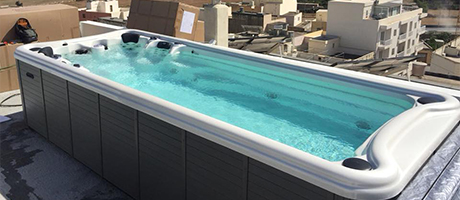
Swim spas, which are larger and designed for exercise as well as relaxation, place even greater demands on their shells. The water turbulence from swim jets requires exceptional shell strength. Fiberglass reinforcement ensures the swim spa remains stable under continuous stress, making it the preferred choice for high-performance models.
6. Maintenance and Care of Fiberglass-Reinforced Spas
While fiberglass reinforcement provides superior durability, proper maintenance further extends the spa’s life:
- Maintain balanced water chemistry to prevent stress on the shell.
- Inspect surfaces periodically for hairline cracks or damage.
- Use proper spa covers to protect from UV rays and debris.
7. Why Manufacturers Choose Fiberglass Reinforcement
Leading spa brands, including Sunrans, use fiberglass reinforcement as a standard feature. The reasons are clear:
- It ensures reliability in international markets.
- It reduces warranty risks.
- It enhances customer trust by delivering a long-lasting spa experience.
8. Key Buyer Insights
For B2B buyers such as hotels, resorts, and distributors, fiberglass reinforcement offers clear benefits:
- Stronger selling point: “Fiberglass-reinforced shell” becomes a premium marketing feature.
- Lower lifetime costs: Fewer replacements and repairs mean better ROI.
- Greater customer satisfaction: End-users enjoy a safer, longer-lasting spa experience.
9. Conclusion
Fiberglass reinforcement is not just an optional feature—it is a fundamental component of spa durability. By strengthening the acrylic shell, resisting cracks, enhancing insulation, and ensuring longevity, fiberglass has become the backbone of modern spa construction.
For homeowners and businesses alike, choosing a spa with fiberglass reinforcement means investing in durability, reliability, and long-term satisfaction.

点击右上角
分享给朋友吧







 Long by picture save/share
0

English
- 中文
- English
Share to:  |
|
Copyright© GUANGZHOU SUNRANS SANITARY WARE CO.,LTD
粤ICP备17099389号-2
Contact us
Tel: +86-20-86181657 Email: sales@sunrans.com
Share to
Contact us Tel: +86-020-26231998 Email: sales@sunrans.com Post code: 511300
Copyright © GUANGZHOU SUNRANS SANITARY WARE CO.,LTD 粤ICP备17099389号
